
Resources for Building a More Connected Community
Practical guides, frameworks, and tools for schools, public safety, community organizations, and leaders working to strengthen preparedness together.
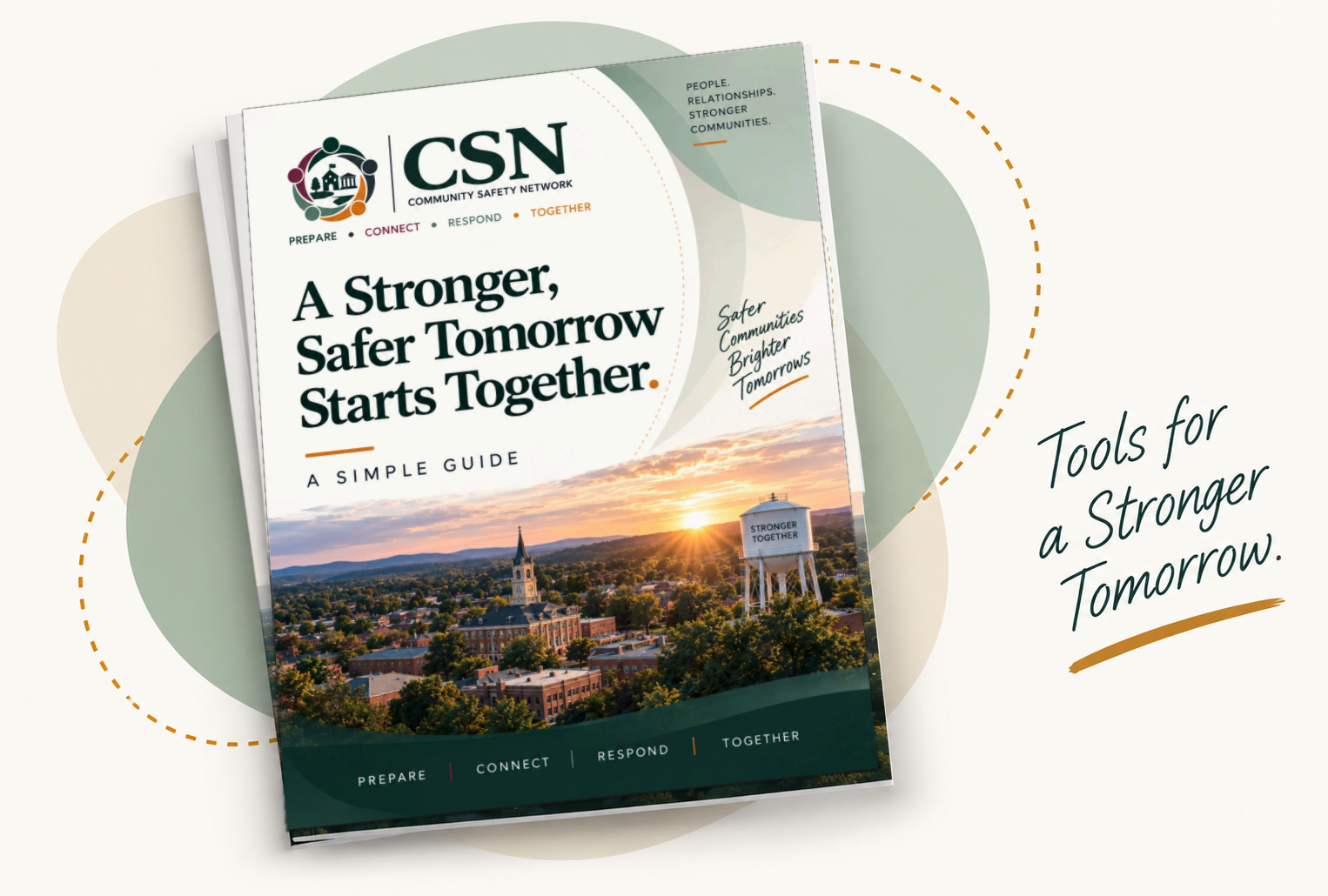
Community Safety Network Simple Guide
A practical framework for bringing schools, public safety, local government, healthcare, businesses, nonprofits, and other community partners together around shared preparedness.
Guides & Briefs
Beyond the Alert: Alyssa’s Law
Why a faster alert needs a connected community readiness system to become a coordinated response. Includes the four questions leaders should be able to answer and a practical first 30 days.
Connected Communities Build Safer Communities
A look at the Community Safety Network model, the principles behind it, and what community leaders can take away and put into practice.
One Current EOP. Every Connected Agency.
Learn how the no-cost program works for districts and why agencies participate. Provided by technology partner CrisisGo.
Standard Response Protocol & Standard Reunification Method
The “I Love U Guys” Foundation’s SRP and SRM are referenced throughout the network’s practice guidance and walkthrough.
Community Connection Assessment
Choose your organization, mark the partners you have working relationships with, and see which relationships would strengthen your position most.
It is not a risk assessment, a certification, or a guarantee of readiness. Use the result to start a conversation with the partners it names.
Step 1
Select your organization
Your role determines where gaps exist and how much each community partner strengthens your response.
Step 2
Who are you connected with today?
Mark every partner you have an accepted working relationship with: named people on both sides, shared plans or contacts, and an agreed way to communicate during an incident. The number is the illustrative weight each partner carries for a .
What this often looks like in practice
Connect with next
Partners whose direct relationship would add the most. Start with one conversation.
What your connections add
Gaps still open
How the assessment works
The Community Connection Assessment is a free, 30-second tool that estimates how well an organization is connected to the partners that matter in an emergency. You choose one of twelve organization types (school district, school, law enforcement, fire, EMS, emergency management, ESA/ROE, hospital, mental health provider, house of worship, business, or childcare center), then select the partners you already have working relationships with.
Every organization starts at a baseline of 25 percent, representing an isolated response. Each connected partner adds points weighted by how much that partner strengthens your particular role, with diminishing returns after the third and fifth partner. Covering more of the six capability areas (threat awareness, emergency communication, coordinated response, medical support, recovery support, regional coordination) adds a coverage bonus, and proven partner pairings such as Fire + EMS or Emergency Management + ESA add a synergy bonus. Scores are capped at 96 and map to the five stages of the model's maturity guide: Isolated (25–40), Aware (41–55), Coordinated (56–72), Connected (73–88), and Practiced and sustained (89–96). The stages are developmental, not a certification. The result also lists the three highest-impact partners you have not connected with yet.
This tool illustrates how direct community relationships improve coordination, communication, and response. Scores are illustrative, based on coordination strength, capability coverage, and partner alignment. They are conversation starters, not a risk assessment, certification, or guarantee of readiness. Nothing you enter is stored.
Turn Your EOP Into a Connected, Living Plan.
EOP Builder helps schools take their Emergency Operations Plan out of static PDFs and into a structured digital workspace that’s easier to build, maintain, review, and share with public safety partners.
Keep critical plan information current, connect with the agencies your school relies on, and create a stronger foundation for coordinated preparedness.
One scenario, two communities.
A fictional school emergency from the first warning signal to the after-action review. At each phase, flip between a community whose organizations hold direct, practiced relationships and one whose organizations are connected only through a relay.
The school is the setting; the lesson applies to any organization in the network. All people, places, and units are fictional.
Interactive walkthrough
Planning & Training
Use the arrow keys, the phase list, or the controls to step through.
Event timeline · connected · time compressed
Outcome
The difference is the relationships, not the equipment.
Every organization in both versions is capable. In one, they already know each other.
Relay-only community
- Delayed alerts
- Limited visibility
- Radio-only coordination
- Disconnected agencies
- Chaotic reunification
Interconnected community
- Instant multi-agency alerts
- Shared live map
- Visible command
- Unified communication
- Structured reunification
Use this as a tabletop warm-up.
Walk your partners through it together, then ask which version your community would be in today, phase by phase.
What the walkthrough shows, and what it does not
The Connected Response Walkthrough steps through a fictional school emergency in nine phases: planning and training, an anonymous tip, alert activation, the live map, command established, tactical deployment, multi-agency response with fire and EMS, reunification, and the post-event hot wash. At each phase you can flip between a connected community, where schools, 9-1-1, law enforcement, fire, EMS, and district leaders share one operating picture, and a fragmented response, where each agency works from separate tools, radio traffic, and phone trees. A timeline compares how long the alert, dispatch, arrival, command, coordination, and reunification stages take in each mode, and an event log accumulates what each partner knew and when. The scenario is illustrative. It does not measure any community, and nothing in it depends on a particular product.
This walkthrough is an illustrative scenario. “Lincoln High School” and all people, places, and units are fictional. The Standard Response Protocol and Standard Reunification Method are programs of The “I Love U Guys” Foundation.